What are the most important qualities for working well as part of a film production team?
For working well together as apart of a film production team, you all need to be prepared. This just makes the day easier if you know what you’re doing, for example having a completed shot list. Also this leads to having good communication skills, this will allow you and everyone apart of the team to know clearly, what is going on and what they have to do. This avoids any time waisted on set, but also this avoids any mistakes from happening, for example a wrong shot being taken. Teamwork is vital, it’s so important to have a good working atmosphere on set, as this avoids stress and arguments that may happen. If you don’t have teamwork, this will slow down the day and make it more frustrating to get through. In my group we was good at timekeeping, as we already planned out how much time we was going to spend in different locations. We was all reliable as we all really contributed to the film and presented professionalism. We all had good teamwork skills by sharing ideas and communicating well, this was pre production and post production. Also we did a risk assessment to work safely and we made sure we avoided any hazards.
What have you learned about potential progression routes into film and connected creative industries?
I have learnt that there is many different ways to get into the film Industry. One way is through apprenticeships, in this you study and learn about the film industry, while actually visiting sets and working on them to gain knowledge and experience.
Entry-level jobs are usually part time jobs, in which the person will learn about the norms and values about the film industry, this is typically aimed at people without experience.
Studying at university is a huge benefit, as you gain access to to all the equipment, as well as doing assignments for the film industry, you also get the will to use the equipment to make you’re own films. Therefore you can promote your films to gain access to supportive viewers, while also emailing your films to producers, writers and more.
There are also online opportunities, one major opportunity you can find online is that you can get a short film entered into a film festival. This is an amazing opportunity as when networking, you get to share your film with important people in the industry and exchange contacts to gain more work. Also there are many residential opportunities ( for example with the BFI) where you get to gain more experience in a specific role in the film industry, for example in script writing or producing. Finally there are also short film competitions, in which you can enter your plot to your film to gain a budget if yours is successful.
The film industry culture is heavily based on teamwork and cooperation. To create a film, it’s vital that everyone works together in a professional manner to get the job done. The whole team is very large and has a lot of roles and responsibilities so it’s important that everyone works together to produce the director’s vision, or what is wanted from the producer. In the film industry the hours can be massive depending on your role, however the hours can vary, for example actors, depending on what scene’s there in and what role they play they can be on set all day. Producers may also be working long hours, both on set but also going to meetings and sorting out paper work. However a make up artists maybe working a short shift to do 1 actors makeup.
In terms of travel this also varies, as different shots wanted can be in many different area’s, this is why it’s vital to have a driving licence, or the film could be in one particular area. For freelance, the film could be Independent and not have many roles, or the film could be sponsored by different companies, and working with many different companies. If independent, you may find that the producer maybe the Scriptwriter And Director, which will require a lot of work. However if working working with different companies, you may have a bigger budget, therefore they maybe many roles which can get different jobs done. Films also have a budget, depending on companies and who you are working with, this budget can vary. However there are steps to gain a budget, such as presenting your movie ideas to a team who will offer you a budget and therefore an agreement will be made. However, depending on the budget you get, this can effect different shots you get and how much time you have to film, and sets you get to work on. Therefore this can create a lot of pressure for set times, how much times you get to have equipment and how much shots you get.
Some positives towards the film industry is that you get to meet so many different people, which is great as networking is essential, you also get to experiment with different themes and ideas to catch attention from different areas. I feel the negatives to the film industry is that it can be very hard to get into, and also a lot of people are scared to take leaps as they feel they need to stay in a particular box (making love films, action etc) to gain a career, however there is many more powerful movies that can be made. To work in the industry, you need to be majorly resilient and believe in the work and what you do, you need to have good teamwork skills and be able to work under pressure and stressful times, this is all important as it really is a team effort, and making a film with positivity and hardworking people will make the process more enjoyable.
Me personally, I have learnt again, that teamwork is essential, as you really do need to be communicating at all times, expressing ideas and telling people what plans are. I’ve learnt that you need to know what you are doing, and always be prepared. But the biggest thing I’ve learnt is that you really do need to work hard in the industry, for example you need to know everything in what your job is, but you also need to get yourself out there, this includes posting work, working on your platform, gaining followers that appreciate your work. This is all vital as you need an audience that will respect you and support you.
In this session, we talked to Yen Yau, who gave us a presentation about the film industry and working in film. In the session, we learnt how successful Yen Yau has been in the industry, we learnt that she currently worked in the latest bond film. She also made us aware of questions that maybe asked in interviews,such as why do you like doing a particular role. I found this really interesting as I feel it’s what a lot of people forget. I can admit I do, when I go to an audition I’m just focused on the audition and performing to my best ability, however this has made me realise that I need to prepare myself on questions that maybe asked. She also taught us vital things we need on our CV’s such as a driving license, as film makers are more likely to employ someone who can drive a distance. Yen Yau gave us information about the film industry but also told us to stay open minded in different aspects to the film industry and different roles. In today session we had to start planning our presentation for our films to be shown at the Workstation cinema. I worked with Emily in helping her come up with idea’s in what she can put in her speech. Such as what is the film about. From here we need to work together to develop a speech and to cherish the journey as a whole.
1.4 Review own technical skills and use of equipment
My role within the group was being an actor, I had to make sure I could channel my character and bring Sam to life. I did this through a long process in getting to know Sam’s (my character’s) background and everything about him related to the story, and doing my own research on deafness.However, even though I was acting through out the day, we all played a role in total focus, commitment and teamwork, for example we all helped move equipment and prompted each other with support.
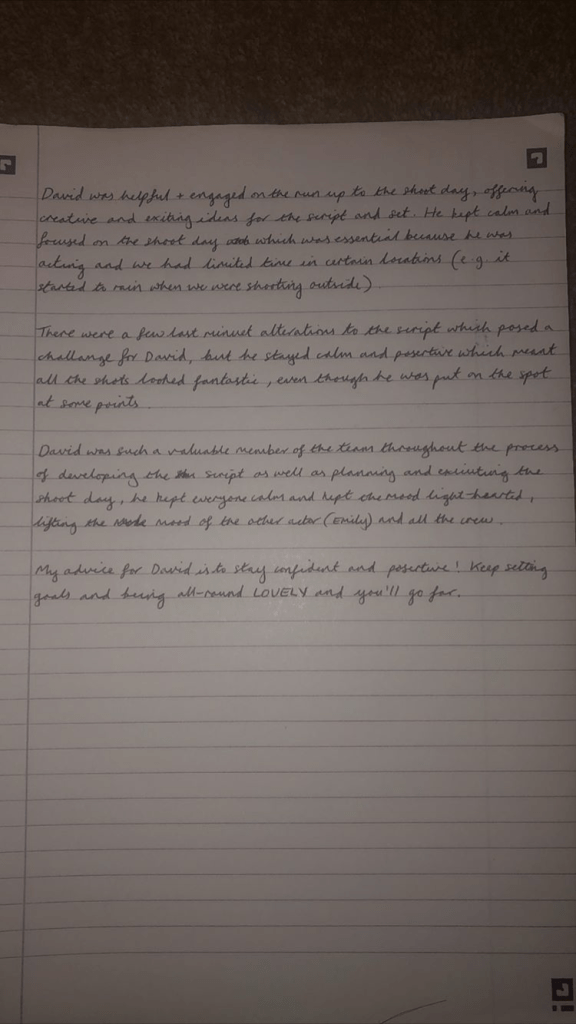
Im really happy with my feedback, my team member Elfie Burn said that I was helpful, engaged and focused. I agree with this, as I adapted myself in a professional mode, this allowed me to engage with my character Sam while being ready for shoots and communicate with all team members. I knew this is the manner i had to be in as it’s so important to remain focused and engage with all members to know what is happening, this speeds up the process and makes things easier while filming.
I carried out my role really well in production, as before production I made sure to know my character really well. I went through all the steps in creating a character, including knowing Sam’s backstory, his motivation’s and his sense data in different scene’s. However while in production, I made sure to help whenever I could while I wasn’t in character or in a scene. I made sure to always prompt people and spread positivity within our group.
While filming, I feel my strengths was staying focused and being ready for all scenes and direction. However my challenges was while performing, knowing where to put my body and head while filming so the camera captures the action in the best way. An example of this is the accident scene in our short. While filming we had to do a couple of takes of this scene in order to capture all my facial expressions while being knocked down on the floor. Performing as Sam, I thought I’d keep my head down and try to move after being knocked over, but actually I learnt I had to move my head up, so the camera captures the action.
Overall my technical filming skills all developed majorly since joining the course! I’ve learnt all different roles, such as the producer does everything! But also I’ve learnt a lot of technical skills as little as where and how to place a camera on a tripod and how to hold a camera. However also I’ve learned that a camera needs a white balance before filming. Also I’ve learnt more advanced technical work such how to work our editing software. This includes how to bring in edits from the settings, using text and making cuts and adjusting the volume. This all was really complex at first, but with more practise the more I got the hang of it, which was great as I made the credits for our film and enjoyed doing it.
All my knowledge has developed significantly of the film production. Technical wise, I’ve learnt how to use different equipment such as the camera and a microphone. I’ve learnt that the microphone needs to be high and close to the performers to capture their voice. I’ve learnt that the camera needs a white balance before filming and also how to place a camera on a tripod. Also for on set processes I’ve learnt that as an actor, it’s pivotal to balance out getting into character while listing to instructions. I’ve learnt about rehearsals before shooting, and also the key terminology- quiet on set, turn over and camera and action. In addition I’ve learnt that a film requires a lot of paper work, such as contracts and a risk Assessments and a shot list, which is really important to know what your doing in each scene. I’ve also learnt that in post production editing makes your film, but it’s so important to edit correctly to capture the directors vision.
In today’s session, we watched a lot short films and talked to Amy O’Hara about further opportunities and what to do next. Today while watching short films, Sam gave us examples of not so good ones, which demonstrated how editing can really impact your short film. Sam really made sure that we get the idea that editing makes the film come alive, and it’s so important that we keep continuity within our shorts, and we make good fades and transitions and that the editing goes well with our story. However from Amy, today I learnt that as an Actor, i need to be getting out there more, this is too short film networking sessions, and short film nights.For me this is great, as I love watching short films so this is a bonus, as I get to watch short films as well as meet people who make these films which is majorly important as an actor, as knowing people and networking is so key!Amy also advices that we watch the credits and look out for key names, such as the casting director and producer so we can email them to try and find opportunities.Today I worked with my team in spotting out potential mistakes in short films that we watched, but also talking about features we really liked, which is amazing as we can take inspiration from these points to put in our films. From here we need to have a creative vision of how our short film will look, luckily we have been blessed with being able to see clips from our film. Therefore we are able to play around with these edits and see what we can do with the film.This is incredible as we can literally see how we can edit our films by making a draft of the editing on apps like iMovie, so this can save us so much time already before the editing day.
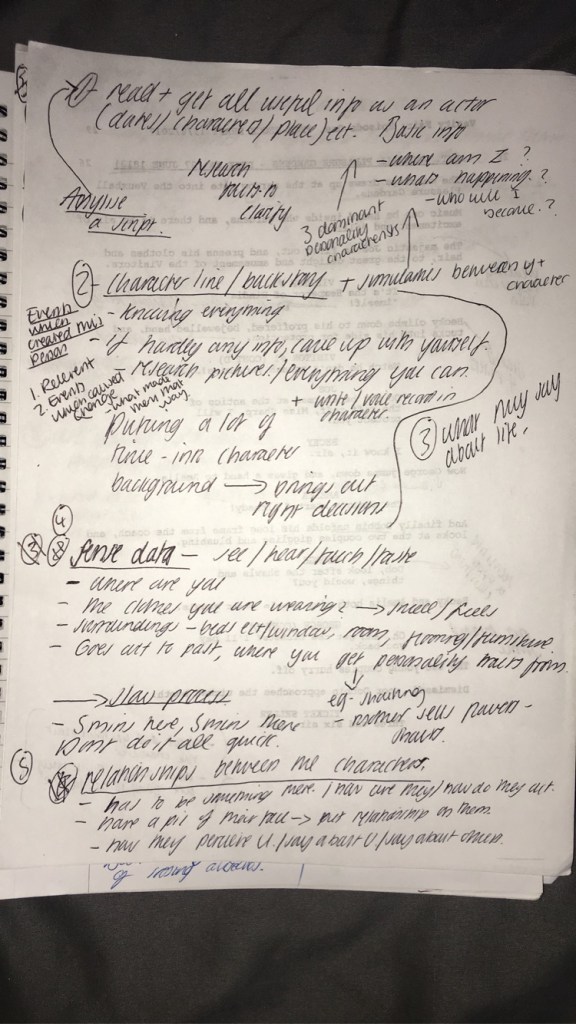
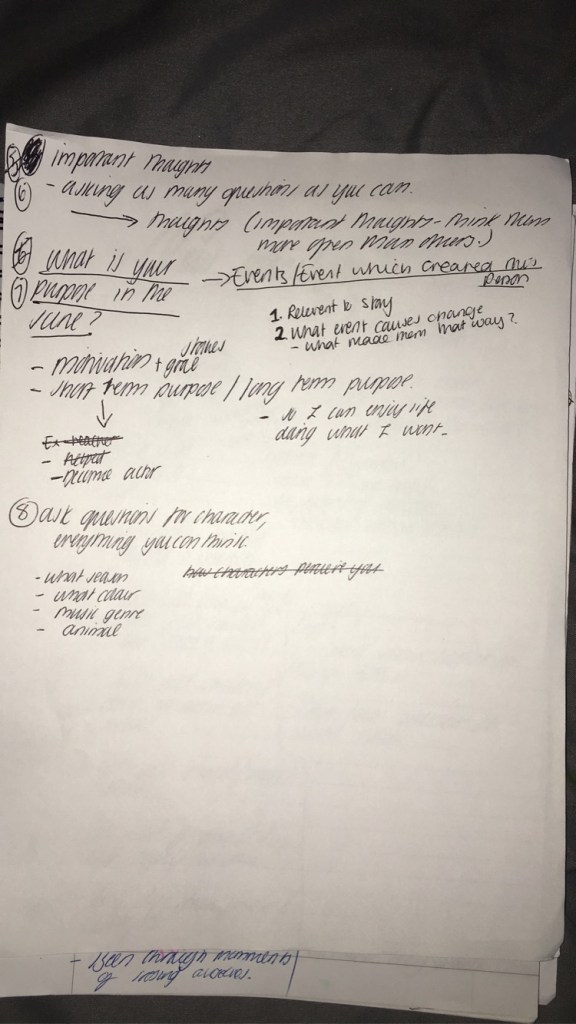
Today, we did an acting workshop with the actor Sally Carpenter. This workshop meant a great deal to me as an actor, but also I have learnt so much from Sally. I think seeing an actor that has done really well gave me hope and motivation to always keep going as an actor.Sally taught us all sorts of things today, some examples are the characters back line; this is the characters backstory. Some key features Sally explained was that creating a character backstory is key, as it determines to an actor with they do as the character.I found this shocking as an actor, as I knew that creating backstories was vital, but actually I learnt that I was doing it wrong. Sally taught me that within a backstory, you need to include as many things as you can, but also make them relevant to the character. She said an example of this was if someone was working class and shouting – their character backstory could be that their parents worked in a market and shouted for people to buy from their stall, therefore that’s where this character gets their shouting from, which makes so much sense! Here are the vital notes I toke from Sally :
As a group, we worked together practically the skills learnt on a script.We chose a character and then we used our knowledge of sense data, back line and how the character thinks of life to use as motivation for the characters actions in the script.I really loved this as I love acting, but also I found it really fun to work with my teammates while bringing a scene to life.
From this point, I need to go away and create a back line for my character Sam, I need to explore the character, and research everything based on the notes Sally gave us today.
In today’s session we did a editing workshop with Darren. In this workshop we learnt how to work the basics of premiere probe, an editing software. This allowed us to gain knowledge of how we would edit our own film we are about to shoot. From my own experience, I have made many monologues and YouTube videos, therefore I have some understanding of creating a short film- using iMovie. However I did find it very challenging first, as premiere probe is very advanced. However after Darren talked us through the basics, i started to get the hang of it. Today I worked with my friend Humera, in editing one of the short films given to us to play with.I found this experience really challenging but also interesting.For example, I learnt how to make fades and transitions, and cuts and split parts of the clips on premiere probe. Me and Humera both worked together closely in helping each other with working the software, but also gaining our creative vision of the film. From this point,I feel me and my team need to develop how our short film will look in editing. For example how transitions will be, we will do this by looking closely at the script and discussing shots and the plot and what we want to achieve in editing to bring the film alive.
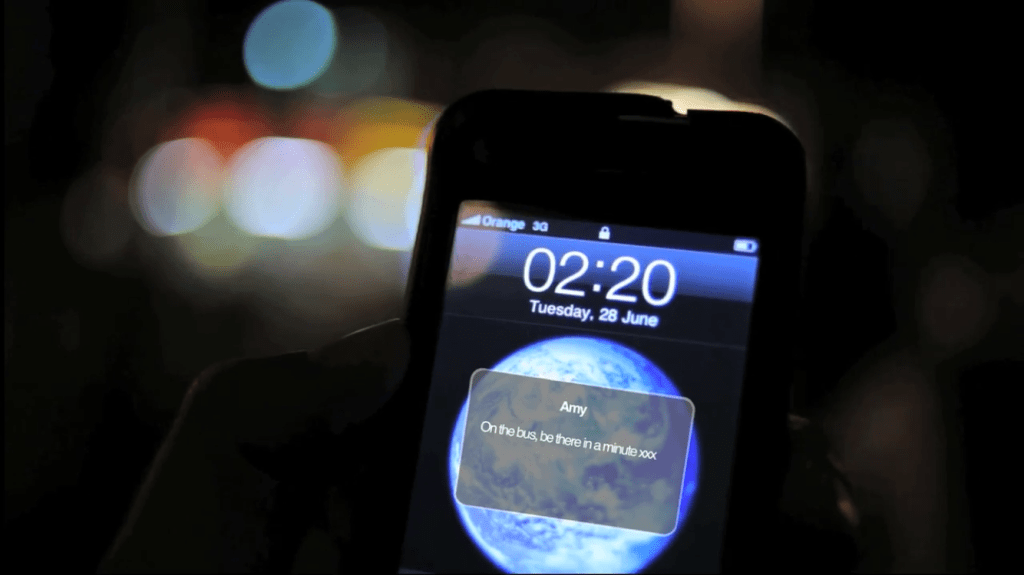
The short film we reviewed was “ two minutes twenty ”, written by Jason Wingard. It was about a man (Dave)who began in the setting of a restaurant .Dave then walks out to see a strange old woman putting glasses in a bin. He then starts to get really intrigued, which motivates him to walk over. Dave tried the glasses on to completely find himself in a new world; the glasses enable him to play God in a way. He gets to see how Long everyone has got left to live. This is really shocking to him to hold this great power, it doesn’t seem right to him, this causing a huge amount of overwhelming emotions and thought. Dave then sees a car, including his reflection – the glasses tell him he has seconds of life left.
I thought the whole concept and idea was amazing! The uniqueness of bringing SYFY and mysterious elements, while including this in the real world I thought was incredible; the short film really captivated me as an audience member. I also thought that playing around with the idea of 2 minutes 20 was significant, I know from my own knowledge, it must have been really challenging making a short film hit 2 minutes twenty exactly! However I also think that including such a great story in 2 minutes twenty is amazing! The production team would have been needing to bring a great demand to capture the special features such as mystical sounds, exotic lighting to add that element of SYFY to the film. This means the person on camera and the editor and producer would have a significant role in coming together to see a creative goal for the setting and to capture this horror like vision. This also links to the make up artist, as they would be needing to make sure that they have spoken to the director to know how the make up will look/ how it’s wanted, also being on a dark road, the person on lighting would need to make sure the actors can be seen. For this short film I find it hard to critique. However the only Thing I have to say is that there are some parts different from the script that are not in the actual short film. An Example of this is in the script theres an old man who gives the glasses to Dave, but in the film it’s an old woman who puts the glasses in the bin.I do not find this a critique at all, as I feel it worked better actually, the old woman gave the film the horror elements and includes a terrifying atmosphere.
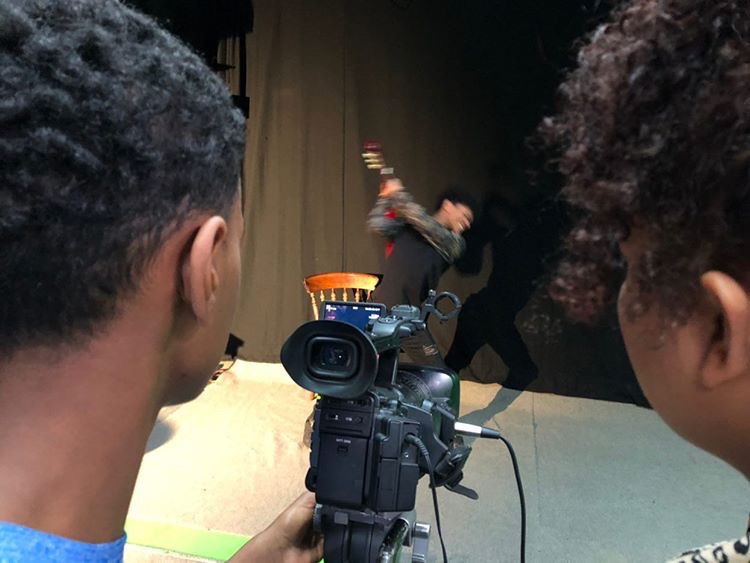
in the session on Saturday the 14th, we shot our short film. Firstly we got all of our equipment ready and then reassured ourselves with how to work the camera. After that we went to our first location, which was the amphitheater; this is where we shot the outside scene, where Rosa (played by Emily Dawson) and Sam (played by David Carpenter) go out.
After a schedule change, we realised we had to shoot this scene first due to the weather that was coming (rain). After this, we shot our studios scenes: Sams accident and Sam smashing his guitar. I really enjoyed this scene as I thought it was quite challenging as an actor-filling yourself with rage and then actually smashing a guitar – it was very different from the performances I’ve done before, but it was amazing! I love challenging myself as an actor.
In addition we then had a break, and then moved onto our final shots: the dancing scene and the after emotions to when Sam smashed his guitar.This was really nice, as it was a nice end of the day, but I got to really express the emotions of deafness affecting me, and it really touched me emotionally.
I have learnt that making / being in film Is really fun, especially when everyone’s coordinating and there’s a positive energy running through the group. It was really fun! Technical wise, I have learnt a more in depth knowledge towards working with everyone on set and handling equipment. It’s crucial that everyone was communicating well and being really clear on what shots we were going for and how the camera should positioned and where we stand as actors. An example of this was before we started shooting our first scene, we had to get in our starting postions but keep moving to get the right angle of the shot.
While filming one way we all worked with each other was by helping with equipment. This was really helpful,especially when it came to transferring ourselves to different locations. It made the job easier and quicker. Another way we worked with each other was with strong communication, this was vital for everything. Examples are us all helping with camera work, while the director helps direct the actors, and the camera crew adjust their equipment to shoot. As an actor I had to make sure I was in character, while working with all of the crew ,listening for instructions ; we had to listen for turning, sound, rolling and action.
From here, we need to develop our film by editing. We need to all work on this, by cropping and adding transitions and fades. Also on the film day, we recorded many muffled sounds and street noise, therefore we need to import this to the film.With good teamwork and resilience our film will have amazing results.
3.1 – Explain the importance of teamwork when working on a film production
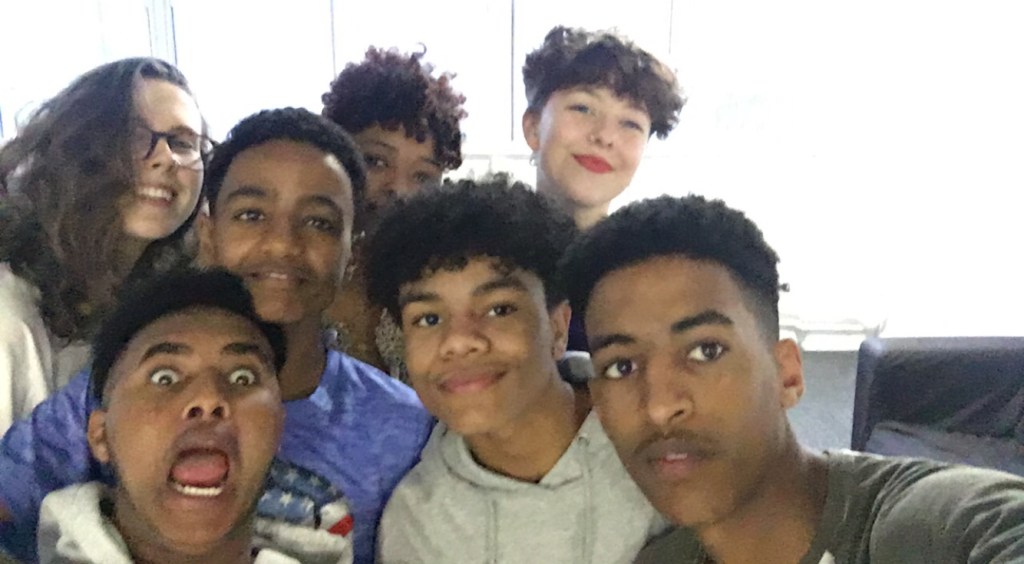
In my team, we have two actors, one DOP, one director, a editor, a producer and camera crew. We all worked together by keeping contact through meetings and group chats. In these meetings we always discussed ideas, what will happen in certain sessions and how we can help to make our film. An example of this was the last session before filming, as a group we had to discuss who will bring props and how we can all contribute to help filming and what to bring on set. However in the group chats, we was able to ask questions and help each other. I really loved this, as it developed our team work and friendships all in one, it allowed us to get to know each other on more personal levels, which made us enjoy all the sessions and work together fantastically. Before the official shoot, our group worked together by discussing and writing our shot list, and helping the producer complete the risk assessment sheet. After this we told each other what costumes to bring, along with props and things like baby wipes just in case.
During production, our group worked together fantastically! We were very grateful for our mentor Rebeca Mark-Lawson, who guided us when we was unsure, some brilliant examples of Rebeca guiding us was telling us postions to get camera to get the perfect shot which our scene required, although we knew what shot we wanted from out shot list, sometimes getting the camera In postions would be tricky. The help guiding us made us all feel confident, but also grew our independence on knowing what to do.
3.3 Describe how you worked with others collaboratively on your film production
From the start, our group established a nice and calm atmosphere to avoid stress, and frustrations, which worked perfectly as it’s majorly important that there’s no complications.We all helped each other moving equipment and getting scenes ready, however as an actor on set, my group was really encouraging but also gave us time to channel our characters when we needed moments.From post production, we have been celebrating our success, and talked about (not in great detail) what cuts to make, transitions in editing and ideas in lighting and sound to import to the the video. We did this while shooting, as we recorded different sounds such as: muffled sounds, outside sounds to get into the video.
If there’s not good team work, I feel straight away this generates a sense of downfall, and a unsuccessful day shooting.This is not ideal, as this could result in no shots, arguments and pure negativity.
In my team, there was not one moment where our team didn’t excel in teamwork, we all communicated and supported each other. This effected our production process as being really enjoyable and something that we can cherish.Having no stress and just being focused made the time fly by, but also just made the whole process more enjoyable and I’d love to do it again and for the rest of my life.
1.1 – Describe areas for development in your current knowledge, understanding and skills
In my current knowledge, I feel the areas of development is really getting to know every single part on a film set. For example : all important items on sets, knowing how to work professional cameras and editing camera work. I feel I need to learn what every role does and why it’s vital. After learning this, this will enable me to develop my understanding and skills. However my current knowledge in film, is knowing some particular roles on film sets, such as the script writer, actor and director and producer. I have been able to develop this knowledge by actually being on film sets as an extra on: everbodys talking Jamie and Ackley Bridge. I have also been a main part in a commercial for NSPCC ( Childline ). However, due to trying to promote myself as an actor, I record videos with a Nickon 5500 camera. With this I am able to play with the audio, lightening and editing process from my performance. Therefore this has let me achieve a knowledge into cameras and the acting and editing process of film.
In the Film industry, my main priority is to be an actor, in addition I would still love to try out different parts in film, such as editing and directing movies. I find being able to work with and direct someone is quite thrilling, especially when you can connect with the actors with a creative intention, and you and the actor can see everything in the scene together. Also I love editing, I love being able to create films, such as my YouTube videos and monologues, to make them look like professional videos, but also to capture a movie style look.
From my experience with the BFI, I hope to achieve a sophisticated understanding of roles in film fully, such as the producer and script writer; I will do this by taking notes from the producers and script writers who will come in, but also working with script writer and producer in my team. In the future, I wish to work in the film industry, but just as an actor. So far I have got quite a lot of experience from being in movies, commercials and theatre productions and a TV show. For my future plans, I hope to be able to get a massive job, that will set my career off to working as an actor full time. If this does not happen, I will develop my knowledge as an actor at Drama school.
Down below I have the link to one of my monologues, my YouTube channel and commercial:
My current role on the course is being an actor. I am overly happy with this decision as it’s all I want to do! Im really excited to work with my team to be able to create a fantastic story, and develop this to come to life on camera. Overall, Im really excited to be able to meet so many experienced film makers/actors/ editors and producers and more; Meeting experienced people will enable me to have an idea of the film industry.
I’m very grateful to be able to access all this knowledge, as I find, expanding my knowledge as an actor about the film industry is vital. Before this, i was also the script writer. However, when getting to know our group more, we found out that our teammates mom, Elfie, was a writer. So we thought Elfie was right to script write. We made this decision as it would help the group due to lack of expierence in script writing, but also Elfie was really confident in taking the role and helping us all to produce a quality script
.In this process, we all decided our homework was to get an idea of what we wanted to do. From the first meeting, we knew we wanted a mystery film, so we thought it was best to take notes off of other films and get strong ideas, so when we come back, we could combine these ideas and make a story line.In pre production, as an actor I will work with my team to build a character from the script. Then I will do my independent work ; I will be creating a backstory for them, finding out as many questions as possible and developing relationships between the characters. This will help in post production as from my research and writing for my character, I will be able to channel my character easily while filming.
As an actor, I need the skills of being confident, listening to direction and the team, be able to communicate and play a character in its own essence. The script will really help me, as I will be able to see little details and expand on them to create a character. But also the script shows the characters personality and relationships with others and how they think of life.
2.2 – Describe a range of key job roles and responsibilities in the film industry.
One massive job role in the film industry is the producer. They are in charge and in every section of making a film, they take on huge responsibilities like thinking if key roles on set are needed. They also work very independently on scheduling, finding equipment and employing roles on set like they director.
Another key job role is the script writer. They take on the responsibilities as being creative, writing a lot of drafts, but also making their scripts different and unique. This can be seen as a very powerful role as its vital to a film. The script writer, the actor and producer would need to work with each other very closely, as the actor needs to really understand the story of their character, the plot and the message the producer is trying to achieve. This is when the script writers role helps as they can answer the actors questions, but also the actor could really dive into their creative intentions also. The producer and actor will have meetings about locations , schedules, script work and every detail.
Another key job role is the actor, they have enormous responsibilities such as: really finding the their character and bringing them to life. They have to do a lot of research and understand everything about what’s happening on the plot but as their character. Actors also need to connect with creative vision of the director and the script writer in some cases.
Also a significant key job role in film is the make up artist. Their role is to make sure all actors and artists fit their character look.They have significant responsibilities of being on set on time for their schedule, they need to grasp the directors vision of what the actor/actors should look like. And also they need to be able to have the skill within makeup to achieve a wanted look for the artist. The make up artist would need to work with the director and producer, this way the makeup artist would learn about what make up is required for each scene, what their schedule is and the actors who they will be doing make up on.
In addition, a major key role in film is the Art director. The Art directors role is to make the look of a set, and bring this set to life. They need such a huge commitment, and really have a vivid image of what every detail is on set and capture this reality. They would need to work with the script writer and director, all together this would gain all three roles with more knowledge into the context of the set, and they would share their creative vision to accomplish the art of a set.
To develop my understanding of how all these roles work together in the film academy, I will take notes and place close attention to all the producers, actors and roles in film that will come and visit us. From there I will ask question to gain knowledge from experienced members of film.
 David Carpenter