1.4     Review own technical skills and use of equipment

Production diary:


In this session, we talked to Yen Yau, who gave us a presentation about the film industry and working in film. In the session, we learnt how successful Yen Yau has been in the industry, we learnt that she currently worked in the latest bond film. She also made us aware of questions that maybe asked in interviews,such as why do you like doing a particular role. I found this really interesting as I feel it’s what a lot of people forget. I can admit I do, when I go to an audition I’m just focused on the audition and performing to my best ability, however this has made me realise that I need to prepare myself on questions that maybe asked. She also taught us vital things we need on our CV’s such as a driving license, as film makers are more likely to employ someone who can drive a distance. Yen Yau gave us information about the film industry but also told us to stay open minded in different aspects to the film industry and different roles. In today session we had to start planning our presentation for our films to be shown at the Workstation cinema. I worked with Emily in helping her come up with idea’s in what she can put in her speech. Such as what is the film about. From here we need to work together to develop a speech and to cherish the journey as a whole.


1.4 Review own technical skills and use of equipment

My role within the group was being an actor, I had to make sure I could channel my character and bring Sam to life. I did this through a long process in getting to know Sam’s (my character’s) background and everything about him related to the story, and doing my own research on deafness.However, even though I was acting through out the day, we all played a role in total focus, commitment and teamwork, for example we all helped move equipment and prompted each other with support.

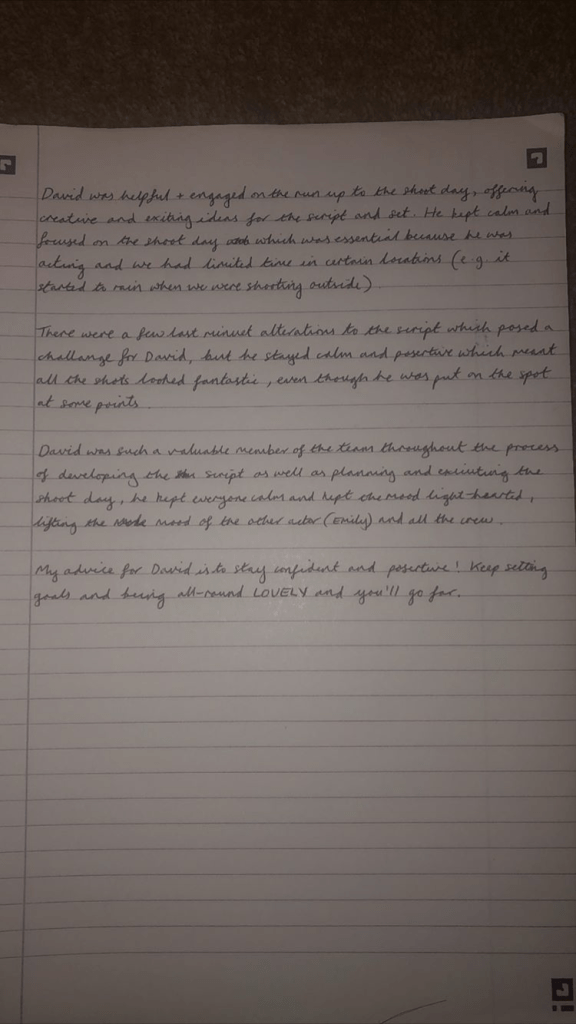
Im really happy with my feedback, my team member Elfie Burn said that I was helpful, engaged and focused. I agree with this, as I adapted myself in a professional mode, this allowed me to engage with my character Sam while being ready for shoots and communicate with all team members. I knew this is the manner i had to be in as it’s so important to remain focused and engage with all members to know what is happening, this speeds up the process and makes things easier while filming.

I carried out my role really well in production, as before production I made sure to know my character really well. I went through all the steps in creating a character, including knowing Sam’s backstory, his motivation’s and his sense data in different scene’s. However while in production, I made sure to help whenever I could while I wasn’t in character or in a scene. I made sure to always prompt people and spread positivity within our group. 

While filming, I feel my strengths was staying focused and being ready for all scenes and direction. However my challenges was while performing, knowing where to put my body and head while filming so the camera captures the action in the best way. An example of this is the accident scene in our short. While filming we had to do a couple of takes of this scene in order to capture all my facial expressions while being knocked down on the floor. Performing as Sam, I thought I’d keep my head down and try to move after being knocked over, but actually I learnt I had to move my head up, so the camera captures the action.

Overall my technical filming skills all developed majorly since joining the course! I’ve learnt all different roles, such as the producer does everything! But also I’ve learnt a lot of technical skills as little as where and how to place a camera on a tripod and how to hold a camera. However also I’ve learned that a camera needs a white balance before filming. Also I’ve learnt more advanced technical work such  how to work our editing software. This includes how to bring in edits from the settings, using text and making cuts and adjusting the volume. This all was really complex at first, but with more practise the more I got the hang of it, which was great as I made the credits for our film and enjoyed doing it.

All my knowledge has developed significantly of the film production. Technical wise, I’ve learnt how to use different equipment such as the camera and a microphone. I’ve learnt that the microphone needs to be high and close to the performers to capture their voice. I’ve learnt that the camera needs a white balance before filming and also how to place a camera on a tripod. Also for on set processes I’ve learnt that as an actor, it’s pivotal to balance out getting into character while listing to instructions. I’ve learnt about rehearsals before shooting, and also the key terminology- quiet on set, turn over and camera and action. In addition I’ve learnt that a film requires a lot of paper work, such as contracts and a risk Assessments and a shot list, which is really important to know what your doing in each scene. I’ve also learnt that in post production editing makes your film, but it’s so important to edit correctly to capture the directors vision. 
1.3 Gain feedback on how you performed your role

In today’s session, we watched a lot short films and talked to Amy O’Hara about further opportunities and what to do next. Today while watching short films, Sam gave us examples of not so good ones, which demonstrated how editing can really impact your short film. Sam really made sure that we get the idea that editing makes the film come alive, and it’s so important that we keep continuity within our shorts, and we make good fades and transitions and that the editing goes well with our story. However from Amy, today I learnt that as an Actor, i need to be getting out there more, this is too short film networking sessions, and short film nights.For me this is great, as I love watching short films so this is a bonus, as I get to watch short films as well as meet people who make these films which is majorly important as an actor, as knowing people and networking is so key!Amy also advices that we watch the credits and look out for key names, such as the casting director and producer so we can email them to try and find opportunities.Today I worked with my team in spotting out potential mistakes in short films that we watched, but also talking about features we really liked, which is amazing as we can take inspiration from these points to put in our films. From here we need to have a creative vision of how our short film will look, luckily we have been blessed with being able to see clips from our film. Therefore we are able to play around with these edits and see what we can do with the film.This is incredible as we can literally see how we can edit our films by making a draft of the editing on apps like  iMovie, so this can save us so much time already before the editing day.

Acting workshop

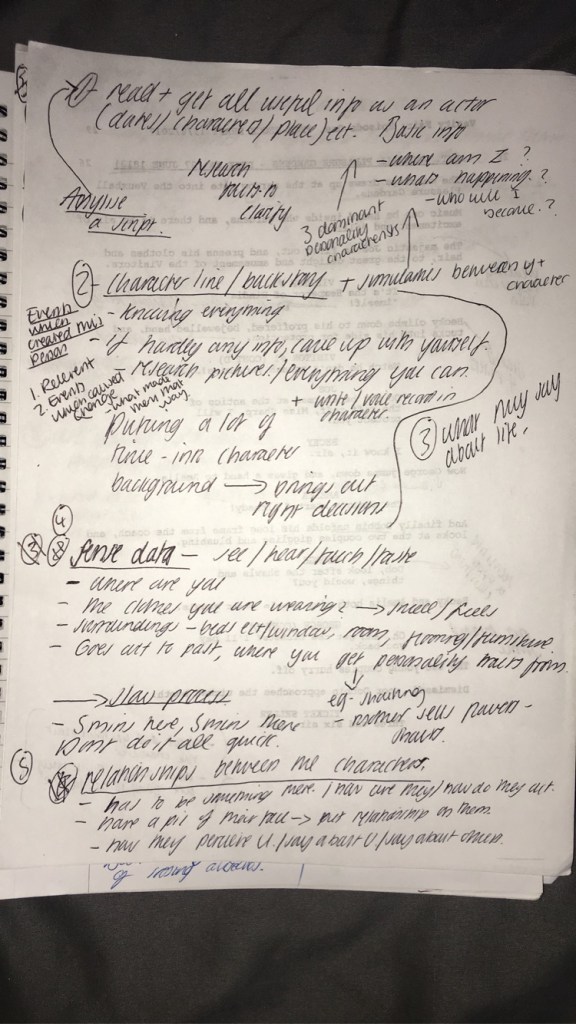
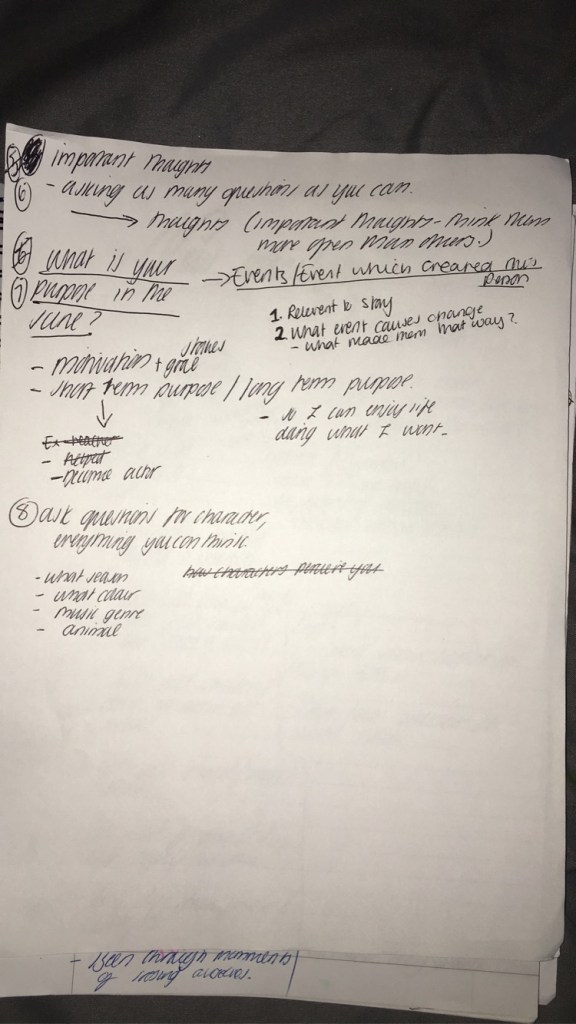
Today, we did an acting workshop with the actor Sally Carpenter. This workshop meant a great deal to me as an actor, but also I have learnt so much from Sally. I think seeing an actor that has done really well gave me hope and motivation to always keep going as an actor.Sally taught us all sorts of things today, some examples are the characters back line; this is the characters backstory. Some key features Sally explained was that creating a character backstory is key, as it determines to an actor with they do as the character.I found this shocking as an actor, as I knew that creating backstories was vital, but actually I learnt that I was doing it wrong. Sally taught me that within a backstory, you need to include as many things as you can, but also make them relevant to the character. She said an example of this was if someone was working class and shouting – their character backstory could be that their parents worked in a market and shouted for people to buy from their stall, therefore that’s where this character gets their shouting from, which makes so much sense! Here are the vital notes I toke from Sally :


As a group, we worked together practically the skills learnt on a script.We chose a character and then we used our knowledge of sense data, back line and how the character thinks of life to use as motivation for the characters actions in the script.I really loved this as I love acting, but also I found it really fun to work with my teammates while bringing a scene to life.

From this point, I need to go away and create a back line for my character Sam, I need to explore the character, and research everything based on the notes Sally gave us today.

Editing workshop


In today’s session we did a editing workshop with Darren. In this workshop we learnt how to work the basics of premiere probe, an editing software. This allowed us to gain knowledge of how we would edit our own film we are about to shoot. From my own experience, I have made many monologues and YouTube videos, therefore I have some understanding of creating a short film- using iMovie. However I did find it very challenging first, as premiere probe is very advanced. However after Darren talked us through the basics, i started to get the hang of it. Today I worked with my friend Humera, in editing one of the short films given to us to play with.I found this experience really challenging but also interesting.For example, I learnt how to make fades and transitions, and cuts and split parts of the clips on premiere probe. Me and Humera both worked together closely in helping each other with working the software, but also gaining our creative vision of the film. From this point,I feel me and my team need to develop how our short film will look in editing. For example how transitions will be, we will do this by looking closely at the script and discussing shots and the plot and what we want to achieve in editing to bring the film alive.

Filming day

Production diary

in the session on Saturday the 14th, we shot our short film. Firstly we got all of our equipment ready and then reassured ourselves with how to work the camera. After that we went to our first location, which was the amphitheater; this is where we shot the outside scene, where Rosa (played by Emily Dawson) and Sam (played by David Carpenter) go out.

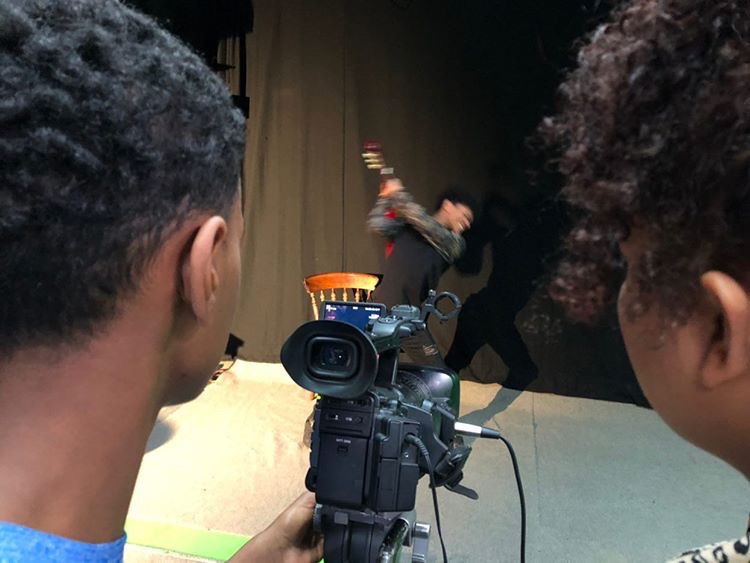
After a schedule change, we realised we had to shoot this scene first due to the weather that was coming (rain). After this, we shot our studios scenes: Sams accident and Sam smashing his guitar. I really enjoyed this scene as I thought it was quite challenging as an actor-filling yourself with rage and then actually smashing a guitar – it was very different from the performances I’ve done before, but it was amazing! I love challenging myself as an actor.

In addition we then had a break, and then moved onto our final shots: the dancing scene and the after emotions to when Sam smashed his guitar.This was really nice, as it was a nice end of the day, but I got to really express the emotions of deafness affecting me, and it really touched me emotionally.

I have learnt that making / being in film Is really fun, especially when everyone’s coordinating and there’s a positive energy running through the group. It was really fun! Technical wise, I have learnt a more in depth knowledge towards working with everyone on set and handling equipment. It’s crucial that everyone was communicating well and being really clear on what shots we were going for and how the camera should positioned and where we stand as actors. An example of this was before we started shooting our first scene, we had to get in our starting postions but keep moving to get the right angle of the shot.

While filming one way we all worked with each other was by helping with equipment. This was really helpful,especially when it came to transferring ourselves to different locations. It made the job easier and quicker. Another way we worked with each other was with strong communication, this was vital for everything. Examples are us all helping with camera work, while the director helps direct the actors, and the camera crew adjust their equipment to shoot. As an actor I had to make sure I was in character, while working with all of the crew ,listening for instructions ; we had to listen for turning, sound, rolling and action.

From here, we need to develop our film by editing. We need to all work on this, by cropping and adding transitions and fades. Also on the film day, we recorded many muffled sounds and street noise, therefore we need to import this to the film.With good teamwork and resilience our film will have amazing results.

3.1 – Explain the importance of teamwork when working on a film production

In my team, we have two actors, one DOP, one director, a editor, a producer and camera crew. We all worked together by keeping contact through meetings and group chats. In these meetings we always discussed ideas, what will happen in certain sessions and how we can help to make our film. An example of this was the last session before filming, as a group we had to discuss who will bring props and how we can all contribute to help filming and what to bring on set. However in the group chats, we was able to ask questions and help each other. I really loved this, as it developed our team work and friendships all in one, it allowed us to get to know each other on more personal levels, which made us enjoy all the sessions and work together fantastically. Before the official shoot, our group worked together by discussing and writing our shot list, and helping the producer complete the risk assessment sheet. After this we told each other what costumes to bring, along with props and things like baby wipes just in case.

During production, our group worked together fantastically! We were very grateful for our mentor Rebeca Mark-Lawson, who guided us when we was unsure, some brilliant examples of Rebeca guiding us was telling us postions to get camera to get the perfect shot which our scene required, although we knew what shot we wanted from out shot list, sometimes getting the camera In postions would be tricky. The help guiding us made us all feel confident, but also grew our independence on knowing what to do.

3.3 Describe how you worked with others collaboratively on your film production

From the start, our group established a nice and calm atmosphere to avoid stress, and frustrations, which worked perfectly as it’s majorly important that there’s no complications.We all helped each other moving equipment and getting scenes ready, however as an actor on set, my group was really encouraging but also gave us time to channel our characters when we needed moments.From post production, we have been celebrating our success, and talked about (not in great detail) what cuts to make, transitions in editing and ideas in lighting and sound to import to the the video. We did this while shooting, as we recorded different sounds such as: muffled sounds, outside sounds to get into the video.

If there’s not good team work, I feel straight away this generates a sense of downfall, and a unsuccessful day shooting.This is not ideal, as this could result in no shots, arguments and pure negativity.

In my team, there was not one moment where our team didn’t excel in teamwork, we all communicated and supported each other. This effected our production process as being really enjoyable and something that we can cherish.Having no stress and just being focused made the time fly by, but also just made the whole process more enjoyable and I’d love to do it again and for the rest of my life.

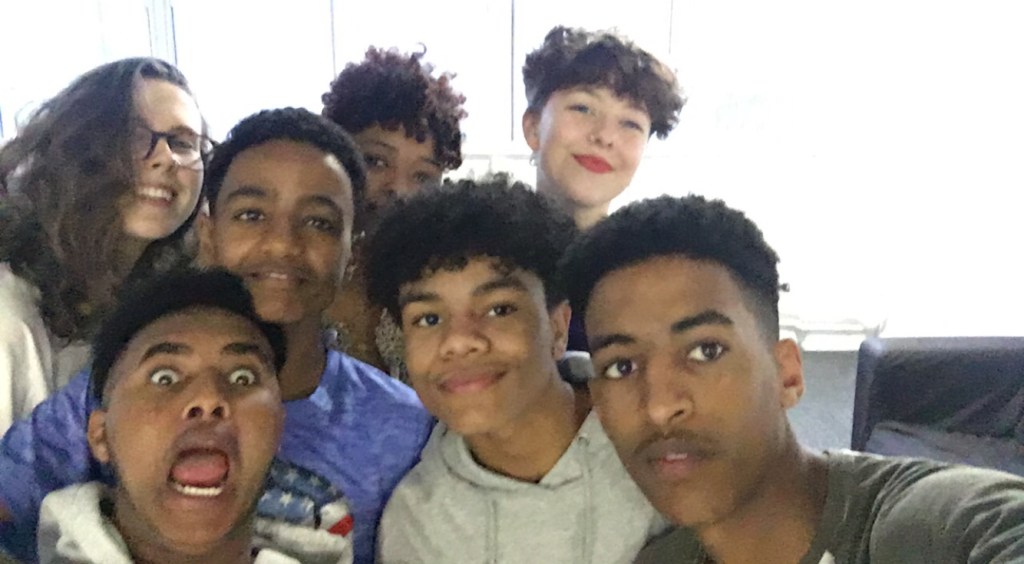
our group

4.1 Demonstrate good health and safety practice when working on film production

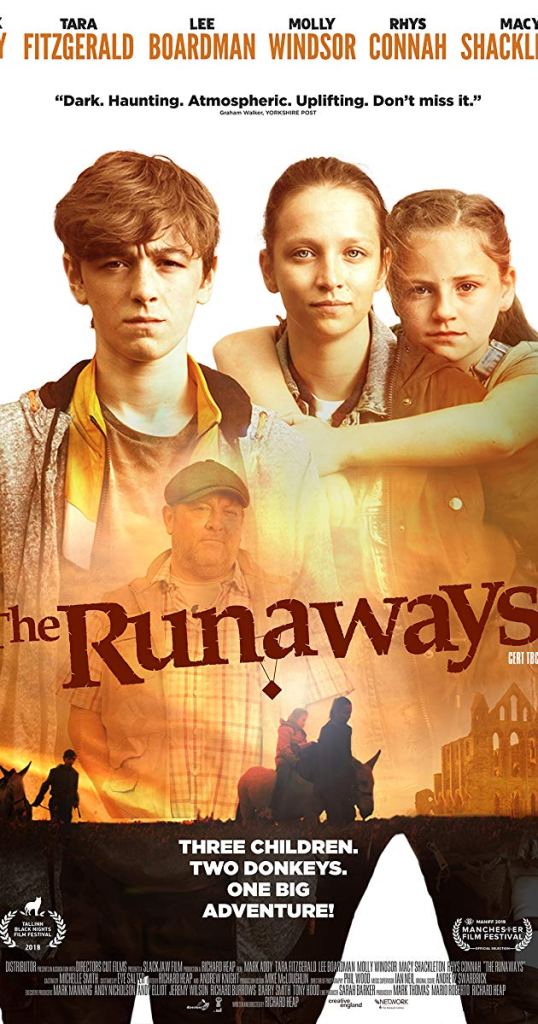
In today’s session, we started by watching a movie preview of a film called “The Runaways”, it was about a family who lived by the sea, and the family is split apart as the Farther dies, this then leads to the uncle trying to capture the children to get an expensive family treasure.I really enjoyed ;it was really authentic and unique.It really captivated me in its story and the setting. The setting was beautiful , it was full of greenery and showed the true nature of the British countryside.After that, we then came together to work on our scripts and develop blocking, probs and locations.

I have learnt that movies don’t need to be like Hollywood films to be great. Also I have learnt a lot of work and effort goes into the process of movie making ; each role in a movie is vital to come movie together ; an example I learnt from the session is getting money for the movie. This is a really hard process, as it can take ages to get loans to achieve the visual imagery what is wanted, and camera equipment is really expensive and on top of that actors need to be payed.

In today session, I worked with my Team developing  ideas further from our first draft ; in our group I’m not the script writer anymore due to changes, but thankfully our first draft is complete so we went through it all – discussing what we like, and what maybe needs to change. We was so happy as a group as we was able to discuss and explain our idea and script with “The runaways” director. Richard  Heap was really impressed with our idea, and gave us some critical advice with probs and camera work.

I feel our next step for our short film is to start to collect all props, and focus on the features of the first draft that we liked, so we can develop these ideas further.Further more I feel we need to start a rehearsal of our scenes as well; as an actor I need to find out every detail about the character Im playing and research and get comfortable with the character Also.

4.1 Demonstrate good health and safety practice when working on film production

Health and safety is majorly important while working on film productions, as everyones health and well being is so important. Health and safety prevents accidents from happening which could cause extreme incidents. An example of this would be moving camera wires so no one trips and falls. Some of the key safety issues relating to film productions is having  a Risk management, this is vital as this ensures- how to avoid any accidents from happening. Another key safety issue relating to film production is making sure all the catering is checked, and everyone has identified what they can eat to avoid things like allergic reactions. Finally, another safety issue relating to film productions is haïr and make up. It’s vital that the products ingredients are checked and that the artist can wear the makeup and beauty products.

When making our film, before we shoot, we will do a risk assessment going to the locations and assessing the area to see what hazards come up, we will then check how we handle probs , for example in one scene, in our recent draft we are going to smash a guitar . Therefore we can get advice and watch videos before hand to avoid any major issues. Both these safety practises are really important as we can avoid any injuries happening but also we can make sure to bring safety equipment, like safety Goggles when smashing the guitar.

4.2 Explain why copyright is important in the film industry

Production diary:

In Today’s session, we learnt how to work professional cameras which are used on film sets.

We had the privilege of being able to use them, creating our own little scenarios (walking around delivering coffee) to expierment and see our weakness’s while filming, an example of this would be someone’s leg being in the shot which wasn’t suppose to be.After learning all the methodology with working cameras, we went back to our groups to develop our short film ideas.

 I have learnt how to work professional film cameras, and what buttons means on the camera, also i have learnt how to safely remove cameras from tripods without damaging them.An example of what I have learnt would be turning the sensitivity down when someone’s speaking in a certain tone, and also to have a white balance before taking a shot.

On Saturday, working with others was pivotal as it’s apart of the professionalism; we had communicate well to get our ideas across, make sure our set was clear to film on, and work with the directors and filming team in our groups to get a clear vision on how the take will look.Going to the end of the session, our team came together to enhance and get our main idea down on paper.

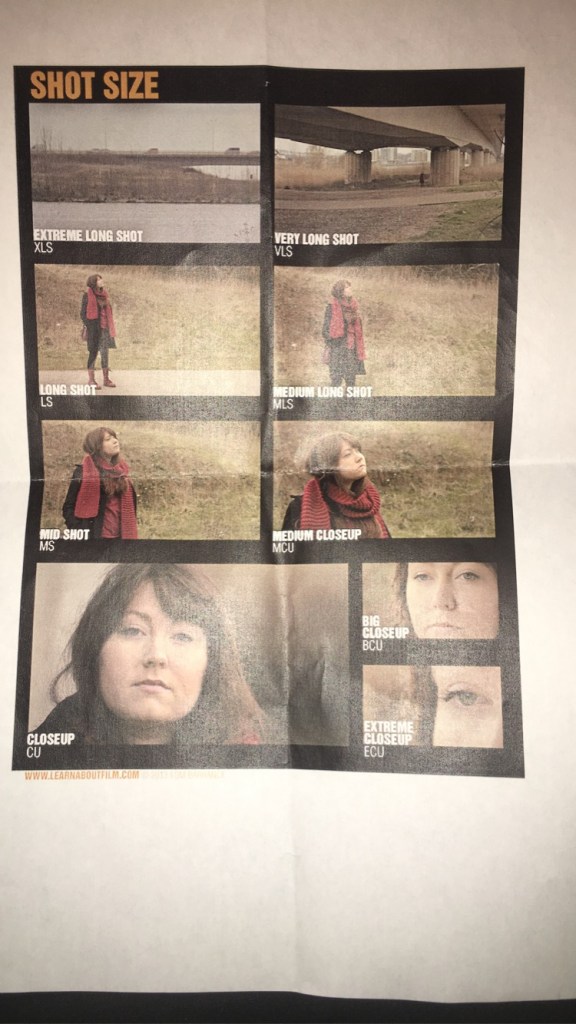
From the previous session, i feel i need to develop how our short film will look on camera. This would be how different shots will look, how are scenes are going to look on camera and locations. To do this, our team was given a shot size list of paper. We used this, with our scripts to evaluate how different scenes will look. An example was in scene 1, when our character Sam is in a accident; me and my team looked at all shot sizes, and made a team decisions, concluding that close ups (Big close ups, extreme closeups) would be vital, to achieve the effectiveness of the accident. This helped us vision and add creativity to our ideas in the script. This was a massive advantage, as seeing which shot sizes we want for each scene, made the shot listing much easier.

4.2 Explain why copyright is important in the film industry

Copyright is so important in the film industry, as when making films, it’s from a unique perspective, it’s the full casts own creativity.This includes all filming, bloopers,logos that the film may have posters etc.If a production doesn’t have copyright, then this can lead to other productions stealing ideas and footage from someone else.

Copyright is a right given to a creator of creative work, to reproduce  the work and to protect the original ideas in the form of a creative work. The copyright law exists to give an author the right to copy and distribute their work. They have the  power to grant creators the exclusive right to control their creation for a limited period of time.

Copyright covers orginal and authentic work of authorship, this includes : literature, art, dramatic work, poetry, novels, movies, songs, computer software, and architecture. If you use copyright material, without permission, you can get taken to court. If you have profited commercially in your film you may have to pay monetary damages.A judge could also impound your material and destroy it. You can avoid copyright by checking the music, materials used in your film, and if it’s already got the use of copyright in it. If it has, you can ask the owner for permission to use the copyrighted piece.You can also use uncopyrighted materials and Record your own content.

Right now, I feel Copyright hasn’t, and other IP regulations haven’t effected our film production.This is because we will be filming our own content, and when it comes to adding In music, we can search for uncopyrighted music and effects to add in our film.However my understanding with IP regulations isn’t so strong, so I need to do more research to avoid our group going against laws and IP regulations.