Production diary:
In Today’s session, we learnt how to work professional cameras which are used on film sets.
We had the privilege of being able to use them, creating our own little scenarios (walking around delivering coffee) to expierment and see our weakness’s while filming, an example of this would be someone’s leg being in the shot which wasn’t suppose to be.After learning all the methodology with working cameras, we went back to our groups to develop our short film ideas.
I have learnt how to work professional film cameras, and what buttons means on the camera, also i have learnt how to safely remove cameras from tripods without damaging them.An example of what I have learnt would be turning the sensitivity down when someone’s speaking in a certain tone, and also to have a white balance before taking a shot.
On Saturday, working with others was pivotal as it’s apart of the professionalism; we had communicate well to get our ideas across, make sure our set was clear to film on, and work with the directors and filming team in our groups to get a clear vision on how the take will look.Going to the end of the session, our team came together to enhance and get our main idea down on paper.
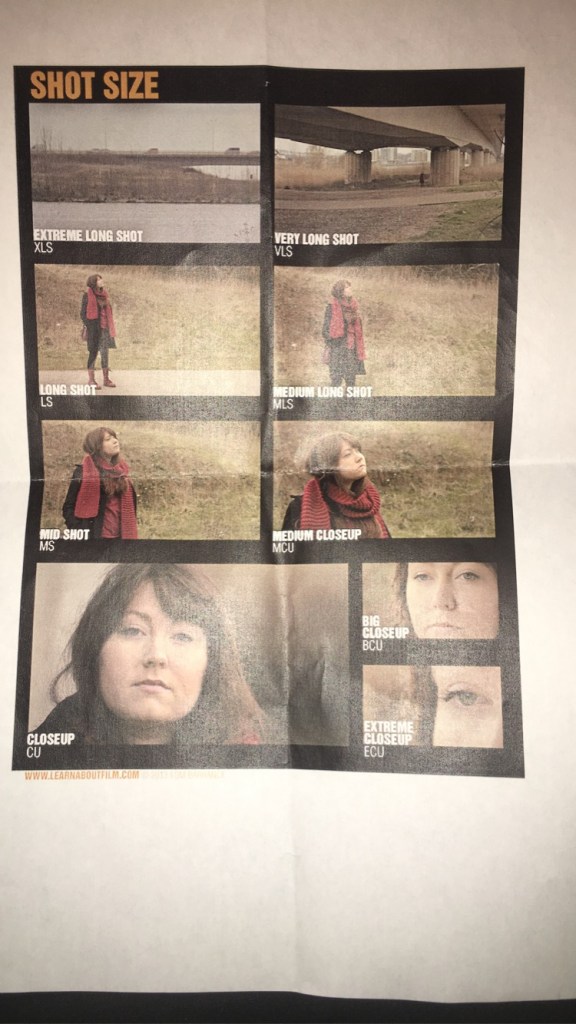
From the previous session, i feel i need to develop how our short film will look on camera. This would be how different shots will look, how are scenes are going to look on camera and locations. To do this, our team was given a shot size list of paper. We used this, with our scripts to evaluate how different scenes will look. An example was in scene 1, when our character Sam is in a accident; me and my team looked at all shot sizes, and made a team decisions, concluding that close ups (Big close ups, extreme closeups) would be vital, to achieve the effectiveness of the accident. This helped us vision and add creativity to our ideas in the script. This was a massive advantage, as seeing which shot sizes we want for each scene, made the shot listing much easier.
4.2 Explain why copyright is important in the film industry
Copyright is so important in the film industry, as when making films, it’s from a unique perspective, it’s the full casts own creativity.This includes all filming, bloopers,logos that the film may have posters etc.If a production doesn’t have copyright, then this can lead to other productions stealing ideas and footage from someone else.
Copyright is a right given to a creator of creative work, to reproduce the work and to protect the original ideas in the form of a creative work. The copyright law exists to give an author the right to copy and distribute their work. They have the power to grant creators the exclusive right to control their creation for a limited period of time.
Copyright covers orginal and authentic work of authorship, this includes : literature, art, dramatic work, poetry, novels, movies, songs, computer software, and architecture. If you use copyright material, without permission, you can get taken to court. If you have profited commercially in your film you may have to pay monetary damages.A judge could also impound your material and destroy it. You can avoid copyright by checking the music, materials used in your film, and if it’s already got the use of copyright in it. If it has, you can ask the owner for permission to use the copyrighted piece.You can also use uncopyrighted materials and Record your own content.
Right now, I feel Copyright hasn’t, and other IP regulations haven’t effected our film production.This is because we will be filming our own content, and when it comes to adding In music, we can search for uncopyrighted music and effects to add in our film.However my understanding with IP regulations isn’t so strong, so I need to do more research to avoid our group going against laws and IP regulations.
 David Carpenter
Hi David,
This is great, but please could you remove the prompt questions so that your answers are less disjointed and flow as cohesive paragraphs. It’s good to be pre-planning the music you will use in your film, so that you can avoid any issues with copyright that you may face. You talk in your production diary about a need to develop how your short film will look on camera — but how will you do this? Please can you explain how it is you intend to develop this skill, and what resources or people you will use to aid you in this endeavour. If you could do this, and answer the questions on module 4.2 Health and Safety by 04/12 that would be great. Thanks David!
LikeLike
Hi Nora, I’m very sorry I’ve been busy with school work, I’ve got this done now, and I’m going to do all the editing you told me two.
Thank you.
LikeLiked by 1 person
No worries at all, David! Thanks for this, and the changes you’ve been making so far are great. Your NCFE portfolio is starting to look really strong 🙂
LikeLike